


Two black sand beaches sit on opposite sides of the same mountain in southeast Santorini. Visitors ask which one to pick almost every day, and the honest answer is that Perissa beach in Santorini and Kamari suit different kinds of days rather than different kinds of people.
Same Mountain, Two Different Beaches
Mesa Vouno is the limestone mass that separates them. Kamari lies on the north face, Perissa on the south.
That single ridge creates the difference. The two beaches are barely two kilometres apart in a straight line, but the drive around takes roughly 20 minutes.
On top of the mountain sit the ruins of Ancient Thera, the settlement founded in the ninth century BC. A footpath links both beaches over the summit.
Stay Within Reach of Both
Karterados sits north of the pair, close enough to reach either in under 20 minutes without paying beach-resort prices.
See our suites in Karterados, read more about the village itself, or ask about availability.
Perissa Beach
Perissa is the larger and busier of the two. Its black sand runs south into Perivolos and Agios Georgios, forming several kilometres of continuous shoreline.
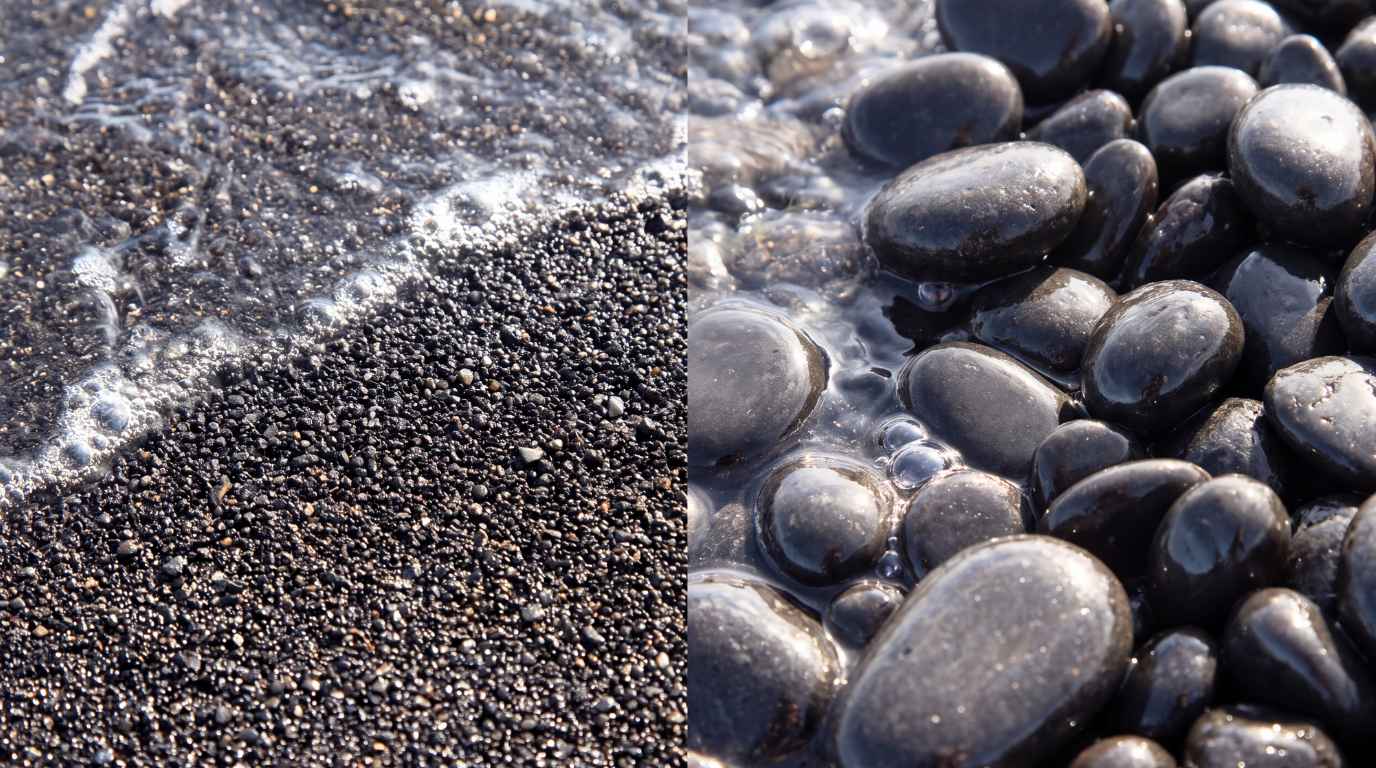
The sand is fine and genuinely black, softer underfoot than Kamari’s pebbles. It also gets hotter, so water shoes matter here.
The atmosphere skews younger. Hostels, budget rooms, beach bars and dive schools shape the crowd.
The shoreline is informal. There is no paved promenade, so the sand runs straight up to the bars and tavernas.
Best for: long social days, groups, budget travel, and walking south into Perivolos for the beach clubs.
Watch for: the sea shelves quickly a few metres out, which surprises weaker swimmers.
Kamari Beach

Kamari is the tidier, more established resort. It has been welcoming visitors longer, and it shows in the infrastructure.
The sand is coarse black pebbles rather than powder. Entry into the sea is firmer underfoot, and the water stays clear because pebbles do not cloud it.
The atmosphere is calmer and more traditional, with a broader age range and more couples and families.
The promenade is the real differentiator. A paved seafront runs the length of the beach, lined with restaurants, shops and an open-air cinema in summer.
Best for: families, couples, dining, and evenings that continue after the beach closes.
Watch for: pebbles are hard on bare feet, and the beach is narrower than Perissa’s.
Side by Side
| Kamari | Perissa | |
|---|---|---|
| Sand | Coarse black pebbles | Fine black sand |
| Sea entry | Firm, shallower gradient | Soft, shelves quickly |
| Promenade | Paved and walkable | Informal, sand to the bars |
| Crowd | Families, couples, mixed ages | Younger, groups, backpackers |
| Dining | Stronger restaurant scene | More bars and casual food |
| Evening | Open-air cinema, dinner | Beach bars, nightlife |
| Accommodation | Mid-range and up | Budget-friendly |
| Airport noise | Closer to the flight path | Quieter |
Which Should You Choose?
Match the beach to the traveller.
- Travelling with young children? Kamari. The firmer entry and paved promenade make the day easier, though Monolithos is calmer still.
- Travelling as a couple? Kamari, for the dining and the evening walk.
- Travelling with friends on a budget? Perissa. Cheaper rooms, livelier bars, more space on the sand.
- Want a long beach walk? Perissa, then continue into Perivolos and Agios Georgios.
- Want the best photos? Neither. Go to Vlychada for the sculpted white cliffs.
- Only have one afternoon? Whichever is closer to your base.
Can You Do Both?
Yes, and the good way to do it is on foot.
The trail over Mesa Vouno connects the two beaches, passing the ruins of Ancient Thera near the summit. Allow two to three hours one way, start early, and carry plenty of water.
The climb is steep and exposed with almost no shade. Avoid it in the middle of a July day.
If you would rather not hike, drive around the mountain in about 20 minutes, or take a boat taxi in summer.
Getting There
Both beaches sit on the southeast coast, well away from the caldera villages.
Approximate drive times:
- From Fira: Kamari about 15 minutes, Perissa about 20 minutes
- From Karterados: Kamari about 10 minutes, Perissa about 15 to 20 minutes
- From the airport: Kamari about 5 minutes, Perissa about 15 minutes
Public buses run from the central station in Fira to both beaches through the summer, and they are inexpensive. Frequency drops sharply outside July and August. For the full picture on transport, see our guide to getting around Santorini from Karterados.
Parking is free at both, but it fills by late morning in high season.
When to Go
June and September give you warm water and manageable crowds. This is the best window for either beach.
July and August bring peak heat and peak numbers. Perissa feels the crowding more because its crowd skews social.
May and October are quiet and pleasant, though some beach bars run reduced hours.
Wind is the deciding factor on any given day. The summer meltemi hits the east coast hardest, so Kamari can be choppy when Perissa is calm. Check the forecast the night before.
The Short Version
Kamari and Perissa are not rivals so much as two moods of the same volcanic coast.
Kamari is the tidy one: pebbles, a paved promenade, better dinners, calmer evenings. Perissa is the loose one: soft black sand, cheaper beds, longer walks, livelier bars.
If you have three beach days on Santorini, spend one at each and give the third to Vlychada or Monolithos, or the quieter Exo Gialos below Karterados. Both are volcanic, and if you are wondering why, read why Santorini’s sand is black. For the full picture, read our guide to Santorini’s beaches.
Planning your stay? Talk to us about your dates.
Frequently Asked Questions
Is Kamari or Perissa better in Santorini?
Neither is objectively better. Kamari has coarse black pebbles, a paved promenade, a stronger restaurant scene and a calmer atmosphere that suits families and couples. Perissa has finer black sand, a longer informal shoreline, cheaper accommodation and a livelier, younger crowd. Choose Kamari for dining and comfort, Perissa for a long social beach day.
How far apart are Kamari and Perissa?
They sit on opposite sides of Mesa Vouno mountain, roughly two kilometres apart in a straight line. Driving around the mountain takes about 20 minutes. A walking trail crosses the summit past Ancient Thera and takes two to three hours one way.
Which beach has better sand, Kamari or Perissa?
Perissa has finer, softer black sand. Kamari has coarser black pebbles that are harder on bare feet but keep the water clearer and give firmer footing when entering the sea. Both are volcanic and both get hot in summer, so water shoes help at either.
Is Perissa beach good for families?
It can be, though Kamari usually suits families better because of the paved promenade and firmer sea entry. Perissa’s seabed shelves quickly a few metres from shore, which can unsettle weaker swimmers. For very young children, Monolithos on the east coast has the calmest and shallowest water on the island.
Can you walk from Kamari to Perissa?
Yes, over the Mesa Vouno ridge past the ruins of Ancient Thera. The hike takes two to three hours one way, climbs steeply and offers almost no shade, so start early and carry water. Most visitors drive around the mountain instead, which takes about 20 minutes.
Which is cheaper, Kamari or Perissa?
Perissa is generally cheaper for both accommodation and food, with more hostels, budget rooms and casual beach bars. Kamari is positioned more towards mid-range hotels and full-service restaurants.
Do Kamari and Perissa have black sand?
Yes, both. The sand at both beaches comes from eroded volcanic rock, which is why it is dark grey to black rather than pale. Perissa’s is finer and sandier, while Kamari’s is closer to smooth black pebbles.