

Santorini Beaches
Quick answer
Santorini’s beaches are volcanic. Lava and basalt eroded over thousands of years into dark grey and black sand, which is why a Santorini black sand beach looks nothing like a pale Mediterranean shore. The main ones are Perissa, Perivolos, Kamari, Vlychada, Monolithos and Exo Gialos, all on the south and east coasts. Perissa and Perivolos form the longest continuous stretch, Kamari is the most organised, and Vlychada is the most dramatic. Dark sand absorbs heat quickly, so bring water shoes in summer. Every beach in Greece is free to access; you pay only for sunbeds and umbrellas.
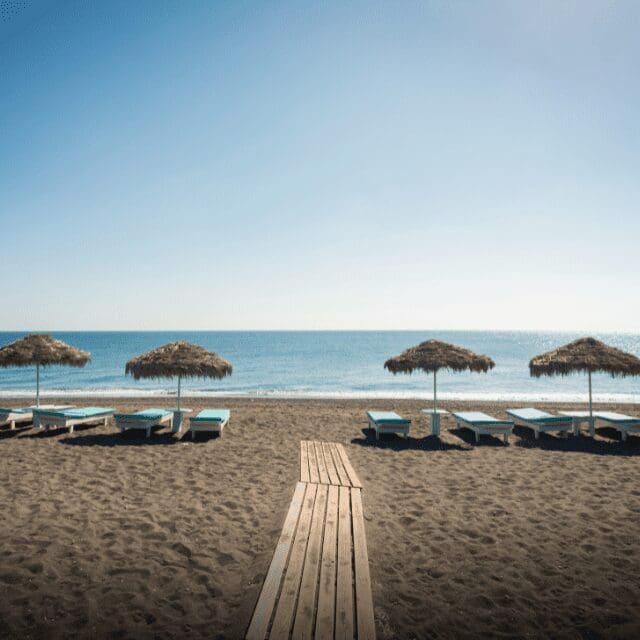
Red, Black, and Volcanic Shores Worth Exploring
Santorini’s beaches look different because the island formed through a massive volcanic eruption. That same history created coves, sea caves, and dramatic coastlines, along with beaches shaped in red, white, and black tones.
Each beach offers its own atmosphere. Some feel iconic and dramatic, others feel calm and practical for an easy swim.
Beyond the sand, discover more things to do in Santorini, or find your base at our suites in Karterados.

Exo Gialos Beach (Karterados Beach)
A Volcanic Shore Close to Karterados
Exo Gialos Beach, also known as Karterados Beach, lies downhill from Karterados village. It features black sand and pebbles, clear waters, and a peaceful atmosphere.
Rock formations shaped by wind and rain surround the beach, creating a strong volcanic landscape that feels raw and natural.
What to Expect
- Black sand and pebbles in a volcanic setting
- Clear water and a calmer mood
- A convenient beach choice when you want to stay close to Karterados
For a closer look, read our full guide to Exo Gialos beach, covering what to bring, when to go and how it compares with Kamari and Perissa.
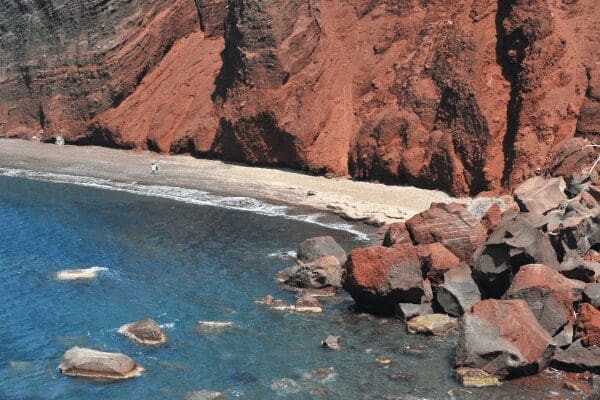
Red Beach
The Island’s Most Iconic Volcanic Setting
Red Beach is one of the most famous beaches in Santorini. The cliffs, sand, and pebbles carry deep red tones that feel unmistakably volcanic.
Located next to Akrotiri village, the beach contrasts striking red terrain with dark blue water.
What to Expect
A dramatic landscape shaped by red cliffs
Red sand and pebbles
A beach experience that feels like a natural landmark
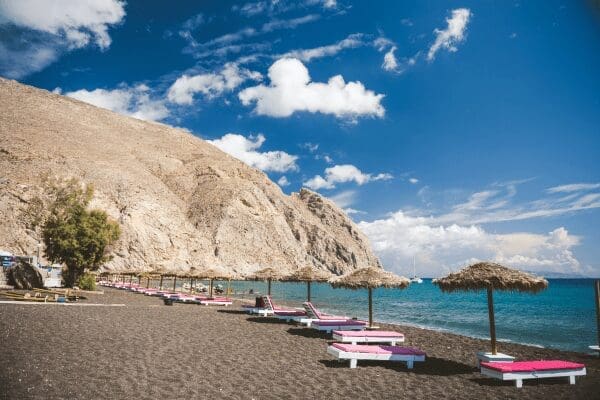
Perissa Beach (Black Beach)
Black Sand and a Distinctive Landmark
On the southeastern side of Santorini, Perissa Beach stands out for its black sand and bold scenery. The large rock formation known as Mesa Vouno shapes the view and gives the beach a strong identity.
Perissa is one of the island’s best-known options for a classic black-sand beach day.
What to Expect
Black sand typical of volcanic beaches
Mesa Vouno rock as a defining feature
A lively, recognizable Santorini beach setting
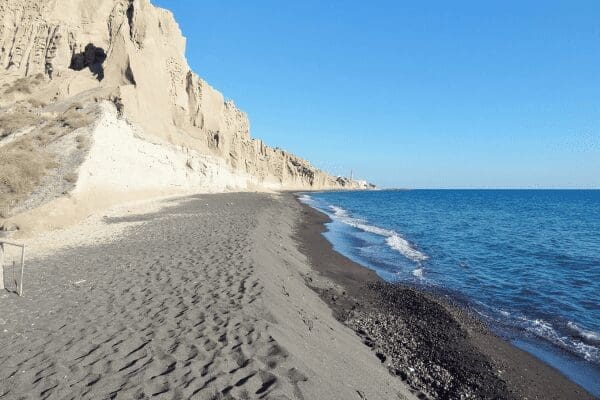
Vlychada Beach
Lunar Landscape and a Quieter Atmosphere
Vlychada Beach combines volcanic white rocks with grey sand, creating a setting that feels sculpted by time. The landscape looks almost lunar, with textures and formations that change as light shifts across the shore.
It is an organized beach, ideal for travelers who want to relax and swim in a setting that feels less crowded.
What to Expect
Volcanic white rock formations and grey sand
An organized beach setup
A calmer choice for swimming and quiet time
Monolithos Beach
Family-Friendly and Close to the Airport
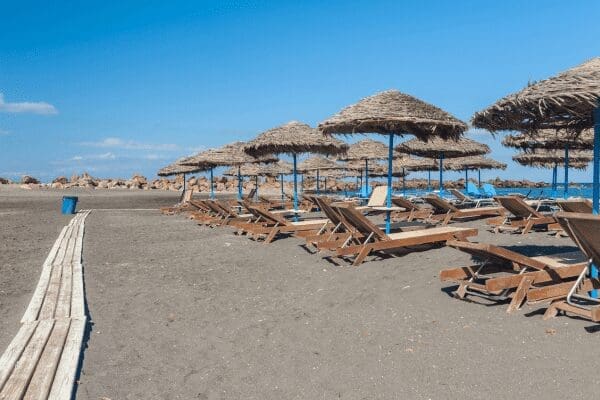
Monolithos Beach is an organized beach with shallow, clear waters and black sand. Its proximity to Santorini airport makes it a convenient option, especially for shorter stays or arrival-day beach time.
It is family-friendly and offers facilities that support a full day by the sea.
What to Expect
Shallow waters suitable for families
Black sand and an organized beach environment
Facilities including a football pitch, volleyball court, and nearby places to eat and drink
Kamari Beach
Black Pebbles Beneath Mesa Vouno
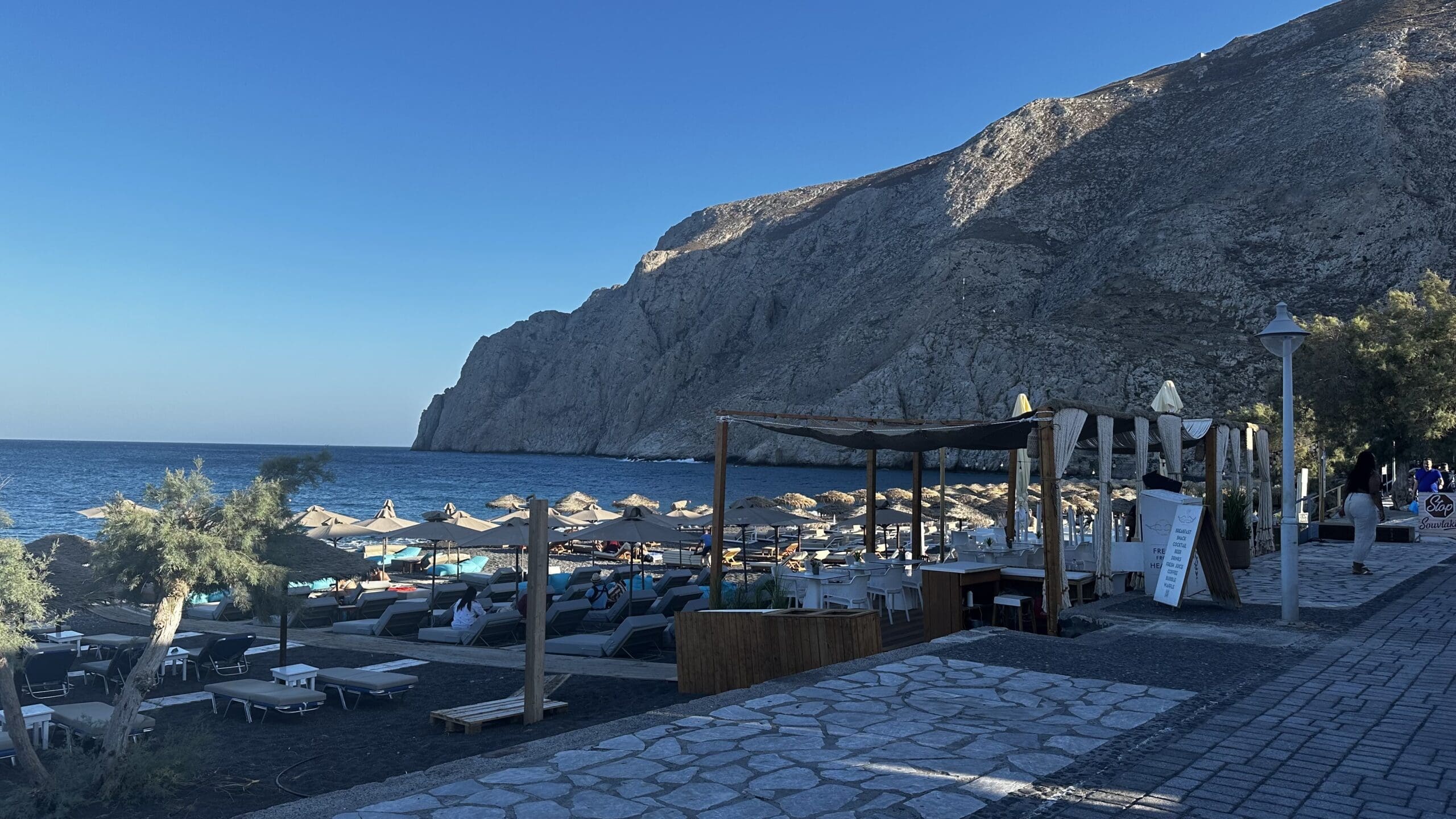
Kamari sits on the opposite side of Mesa Vouno from Perissa. Same mountain, opposite face. The sand here is coarser, closer to smooth black pebbles than powder, which makes entry into the sea firmer underfoot and keeps the water clear.
What to Expect
The tidiest promenade on the island, with a paved seafront, restaurants and an open-air cinema in summer. Best for an organised, walkable beach day with plenty to do after swimming. About 10 minutes from Karterados.
Stay Close to the Volcanic Coast
Karterados sits between Fira and the island’s eastern beaches, which makes it a practical base for beach days without the caldera-edge crowds. Emerald Collection Suites is a short drive from Monolithos, Kamari and Exo Gialos.
Why Santorini's Sand Is Black
Santorini is not an island that happens to have a volcano. Santorini is the volcano.
The island is the rim of a collapsed volcanic cone. Its most famous eruption, around 1600 BC, blew out the centre of the island and left the caldera that cruise ships now sail into.
That eruption, and the many before and after it, coated the island in basalt, pumice and lava. Waves have been grinding those rocks down ever since.
The result is sand made of dark volcanic minerals instead of pale quartz and shell. Grain size varies by beach: some shores are fine and powdery, others are coarse grit or smooth black pebbles.
What that means on the beach
- The sand gets hot. Dark minerals absorb far more solar energy than pale sand.
- The water looks deeper. A dark seabed makes shallow water read as intense blue rather than turquoise.
- The grains are heavier. Volcanic sand does not blow around or stick to skin the way fine white sand does.
Kamari or Perissa? How to Choose
These two get compared constantly, since they sit on opposite sides of the same mountain. Here is how they differ.
Kamari
- Sand: coarse black pebbles
- Atmosphere: tidier, more traditional
- Promenade: paved and walkable
- Sea entry: firm underfoot
- Best for: families, couples, dining
Perissa
- Sand: fine, genuinely black
- Atmosphere: younger, livelier
- Promenade: sandy and informal
- Sea entry: softer, shelves quickly
- Best for: groups, budget stays, nightlife
A practical suggestion: do both. The drive between them takes about 20 minutes around Mesa Vouno, or you can hike over the mountain past the ruins of Ancient Thera and reach the other side on foot.
What Black Sand Is Like Underfoot
Photographs do not prepare you for the heat. By midday in July, dark sand can become too hot to cross barefoot. This is the most common complaint from first-time visitors, and it is easily solved.
- Bring water shoes. They solve the heat and the coarser pebbles at once.
- Take a beach mat or thick towel. Sand transfers heat straight through a thin one.
- Go early or late. Before 11am and after 4pm the sand is comfortable.
- Rent a sunbed on hot days. Being raised off the sand makes a noticeable difference.
- Expect clear water. Volcanic grains settle fast, so the sea stays clear even after waves.
One more thing worth knowing: black sand does not cling. You will leave the beach far cleaner than you would from a fine white sand shore.
Getting to the Black Sand Beaches
Santorini’s dark beaches sit on the opposite side of the island from the caldera villages, so nearly everyone drives, rides or takes the bus. Approximate drive times from Karterados:
- Exo Gialos under 5 minutes
- Monolithos about 10 minutes
- Kamari about 10 minutes
- Vlychada about 15 minutes
- Perissa and Perivolos about 15 to 20 minutes
Buses run from the central station in Fira to Kamari, Perissa and Perivolos through the summer, and they are inexpensive. Services thin out sharply in the shoulder season. Parking is free at all of these beaches, but it fills by late morning in August.
When to Go
The sea is swimmable from roughly June to October. Which month you choose changes the crowds, the heat of the sand and the wind more than the water itself.
June and September
The sweet spot. The sea is warm, the beaches are open, and the crowds are thinner than midsummer.
July and August
The strongest heat and the busiest sand. Black beaches feel hotter than pale ones, so plan around the middle of the day.
May and October
Quieter and cooler. Many beach clubs run reduced hours or close, so check before you rely on facilities.
Watch the wind
The meltemi blows through summer and hits the east coast hardest. On gusty days Vlychada and the south coast are usually calmer.
Practical Details
A few things worth knowing before you go.
- Access is free. Greek law keeps the shoreline public. You pay only for sunbeds, umbrellas and service.
- Sunbed costs vary. Expect roughly 15 to 40 euros for a pair with an umbrella, higher at beach clubs in Perivolos.
- Facilities are seasonal. Showers, changing rooms and lifeguards run mainly from June to September.
- Take the sand seriously. Reflected heat and glare from dark sand increase sun exposure, so reapply sunscreen more often than you would elsewhere.
Frequently Asked Questions
Why are Santorini's beaches black?
Santorini is an active volcano, and its beaches are made from eroded volcanic rock. Lava, basalt and pumice from eruptions, including the major one around 1600 BC, broke down over millennia into dark grey and black sand.
Which is the best black sand beach in Santorini?
Perissa is the best known and has the most facilities. Kamari offers a tidier promenade and coarser pebbled sand. Vlychada is the most dramatic, set against wind-carved white cliffs. Monolithos is the best choice for families because the water stays shallow and calm.
Are Santorini's beaches sandy or rocky?
Both. Perissa, Perivolos and Vlychada are genuinely sandy, though the grains are dark and coarser than white sand. Kamari is closer to smooth black pebbles. Exo Gialos and several smaller coves are rockier.
Are Santorini beaches free?
Yes. Greek law keeps every shoreline publicly accessible, so walking on and swimming from any beach costs nothing. You pay only for sunbeds, umbrellas and service, typically 15 to 40 euros for a pair with an umbrella.
Is black sand hot to walk on?
Yes, noticeably. Dark volcanic sand absorbs much more solar heat than pale sand and can become too hot for bare feet by midday in July and August. Water shoes solve the problem.
What is the difference between Kamari and Perissa?
They sit on opposite sides of Mesa Vouno. Kamari has coarser pebbled sand, a paved promenade and a quieter feel. Perissa has finer black sand and a livelier atmosphere. The drive between them takes about 20 minutes.
Is there pink sand in Santorini?
Not truly. Travellers searching for pink sand are usually thinking of Red Beach near Akrotiri, where iron-rich cliffs and sand can appear rose-coloured in soft light.